 Novedades
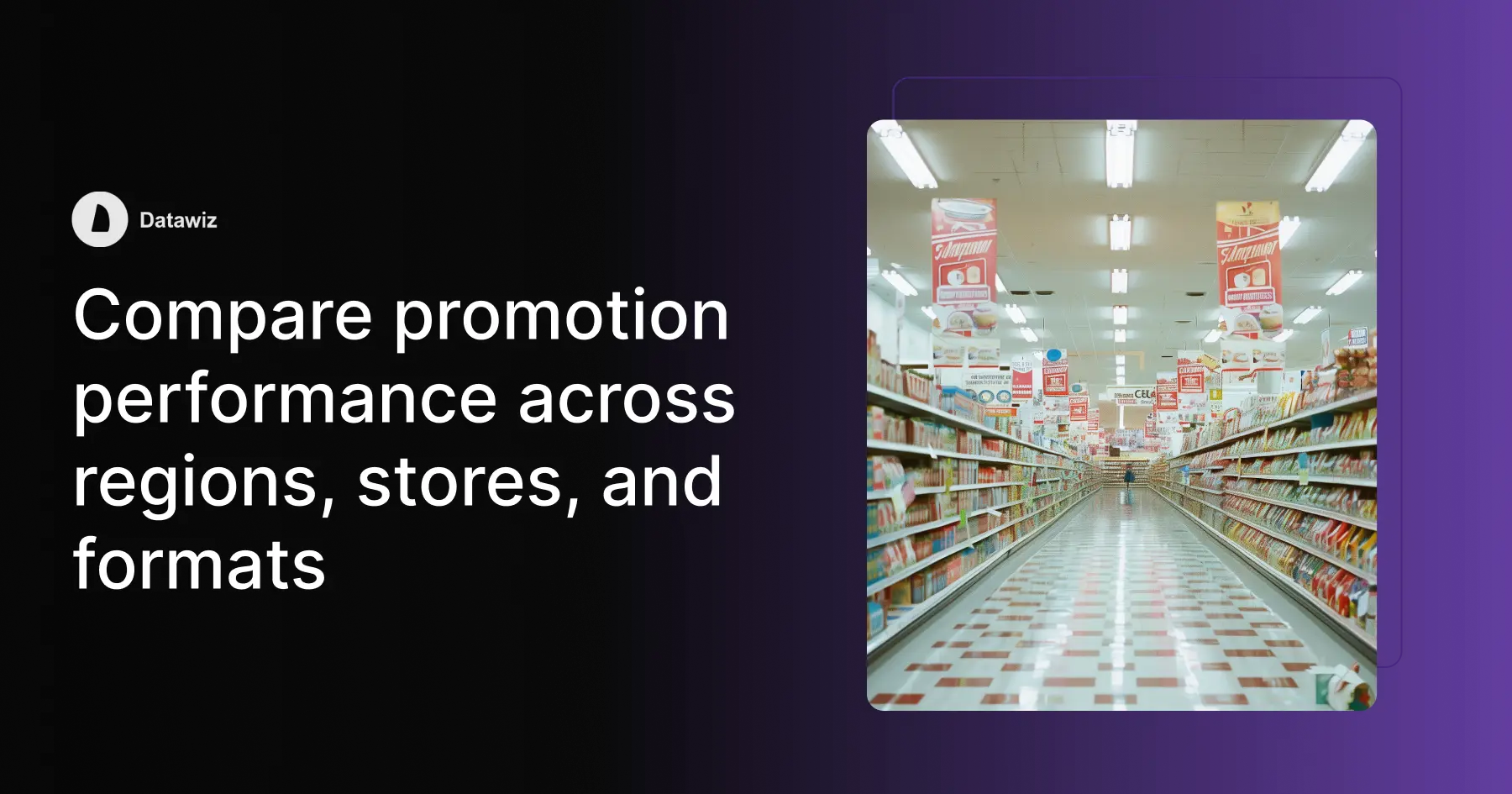

Most shoppers walk into a store already expecting a discount-especially in grocery retail. Beyond simple price savings, they are chasing a sense of advantage: the feeling that they made a smart choice at the right moment. Promotions influence not only what people buy, but how they perceive the store itself. For chain store owners, the challenge is not whether to run promotions, but how customers will react to them across different regions, stores, and formats. Without a clear understanding of promotion metrics, it becomes difficult to tell whether discounts are attracting new visitors, retaining loyal ones, or quietly eroding value. Measuring promotional effectiveness is no longer about counting uplift. A good manager must understand behavior of customers, consistency, and long-term impact.
Key Takeaways
- A promotion that increases unit sales but reduces margin in smaller-format stores produces negative incremental profit chain-wide — even when individual store reports show growth.
- When promotional sales share exceeds 35–40% of total turnover in a category, it typically signals price-driven customer behavior that erodes full-price demand over time; that threshold is the point to investigate, not celebrate.
- Stores with chronic out-of-stocks during promotional periods show uplift 20–30% below comparable locations — the gap reflects replenishment failure, not weak customer response.
- Evaluating ROI store-by-store instead of chain-wide causes management to reinforce tactics that only work under specific local conditions, leading to inconsistent pricing logic across regions.
- Retail chains using integrated BI platforms that connect sales, margin, and inventory data during promotions reduce excess stock by up to 15.5%, because they catch stock imbalances before they scale.
What Promotion metrics actually matter at scale?
Running promotions across a chain changes the nature of measurement. Metrics that look convincing at a single-store level often lose meaning when applied across regions and formats. At scale, promotion effectiveness analysis should help predict losses, identify weak execution early, and show how customer behavior shifts under discount pressure. The metrics below are worth tracking because they remain comparable across stores and support decisions that affect the entire chain.
1. Change in Sales of Promotional Products, %
Formula
Change in Promo Sales, %=(Promo Period Sales−Baseline Period Sales) / Baseline Period Sales ×100%
Why it matters
This metric shows whether a promotion actually increases demand for the promoted SKU compared to its normal sales level. At scale, it helps identify where promotions generate real uplift and where growth is artificial or absent. When this indicator varies significantly between regions or formats, it often signals differences in customer sensitivity, assortment relevance, or execution quality.
2. Share of Promotional Sales, %
Formula
Promo Sales Share, %=Sales of Promotional Products /Total Sales ×100%
Why it matters
This metric shows how dependent a store or region is on promotions. A rising share of promotional sales may indicate strong discount appeal, but it can also point to margin pressure and a growing group of price-driven shoppers. In practice, when promotional sales share consistently exceeds 35–40% of category turnover, it typically precedes a structural shift toward price-only purchasing behavior — a threshold worth monitoring as an early warning signal. At scale, this helps CEOs understand whether promotions support healthy turnover or slowly reshape customer behavior in a risky direction.
3. Promotion ROI, %
Formula
ROI, %=(Profit from Promotional Products−Promotion Costs) /Promotion Costs×100%
Why it matters
ROI measures financial efficiency, but only when calculated consistently across the chain. For chain-level analysis, it reveals which regions and formats convert promotions into profit and which destroy value despite strong sales growth. Low or negative ROI across multiple stores is an early signal of scale-related losses.
Promotion costs should include markdown losses, marketing spend, and operational expenses, not just advertising.
4. Profit Goal vs. Actual Profit
Formula
Profit Deviation=Actual Promo Profit−Planned Profit Goal
Why it matters
Profit goals anchor promotions in financial reality. Comparing planned and actual profit highlights forecasting accuracy and execution discipline across the chain. At scale, recurring negative
5. Incremental Profit per Promotion
Formula
Incremental Profit=Promo Period Profit−Baseline Profit
Why it matters
This metric shows whether the promotion generated additional profit or simply redistributed existing demand. At chain level, it helps prevent situations where promotions look successful in isolation but add no value to the chain.
What risks do chain retailers face when promotion performance is evaluated in isolation?
Evaluating promotion performance at the level of individual stores can create a false sense of success. A promotion may look effective in one location while quietly weakening performance across the rest of the chain. When decisions are made based on isolated results, risks accumulate unnoticed until they appear in margin decline or unstable demand patterns.
One of the most common risks is misreading demand. A store located in a high-traffic area may show strong promotion results simply due to footfall, not because the promotion itself worked well. Replicating the same mechanics across smaller or differently positioned stores often leads to disappointing results and unplanned losses.
Another risk lies in distorted financial conclusions. A single store may report sales growth during a promotion, while nearby stores experience a drop in full-price sales. Without chain-level comparison, this internal demand shift remains invisible, even though total profit suffers.
There is also a strategic risk. When promotions are evaluated independently, management may reinforce tactics that only work under specific local conditions. Over time, this leads to inconsistent pricing logic, uneven customer expectations, and difficulty scaling promotional strategies across regions and formats.
Example:
A regional flagship store shows strong uplift during a beverage promotion. Encouraged by the result, the chain extends the promotion chain-wide. In smaller stores, the same discount increases unit sales but reduces margin and slows turnover of higher-margin alternatives. Because results were judged store by store, the chain misses the fact that total promotional ROI declined.
How comparing promotion performance across stores exposes operational and execution issues
When promotion performance is compared across stores, patterns begin to emerge that are impossible to detect in isolated analysis. Differences in results often point to execution gaps rather than demand differences.
One common issue is inconsistent availability. Promotions assume stock presence, but stores with frequent out-of-stocks naturally underperform. Chain-level comparison highlights stores where promotional lift is consistently below average, often revealing replenishment or forecasting problems rather than weak customer interest.
Another frequent problem is uneven in-store execution. The same promotion can produce different results depending on shelf placement, signage clarity, or staff compliance. Comparing promotion effectiveness across stores allows owners to see where execution standards are not being met.
Operational timing also plays a role. Some stores activate promotions late, end them early, or fail to synchronize pricing systems. These issues rarely stand out in individual store reports, but become clear when performance deviations are viewed across the chain.
Example:
A chain runs a weekend promotion on fresh products across 120 stores. Most locations show moderate uplift, but a group of stores consistently underperforms. Comparison reveals these stores receive deliveries later in the week, leading to limited freshness during peak promotion days. The issue is operational, not promotional, and would remain hidden without cross-store analysis.
How to choose a BI system for promotion analysis across a retail chain
When promotions scale across dozens or hundreds of stores, spreadsheets and generic dashboards stop being reliable decision tools. Retail chains that switch to integrated BI platforms report up to 28% improvement in per-SKU financial outcomes and a 14.7% reduction in operational costs — results driven primarily by earlier detection of underperforming promotions before they are replicated chain-wide. Choosing a BI system for promotion analysis is not about visualizations or data volume-it is about whether the system can reflect how promotions actually behave across regions, formats, and operational conditions.
Below are key criteria that matter specifically for chain retailers.
1. The System Must Support Chain-Level Comparisons by Default
A suitable BI system should allow promotion performance to be compared simultaneously across stores, regions, and formats. This comparison should not require manual filtering or custom report building each time.
Why this matters:
Promotions rarely fail everywhere at once. Losses usually appear in clusters-specific regions, store formats, or operational setups. Without built-in comparison logic, these patterns remain hidden and decisions are based on averages that mask real risks.
What to look for:
- Side-by-side performance views across stores
- Region and format segmentation without additional setup
- Ability to track the same promotion under different conditions
2. Promotion Metrics Should Be Embedded, Not Reconstructed
A BI system built for retail promotion analytics should already include key promotion metrics such as uplift, ROI, cannibalization, and incremental profit. If teams have to recreate formulas manually, consistency breaks down quickly across the chain.
Why this matters:
At scale, even small differences in calculation logic lead to contradictory conclusions. Embedded metrics ensure that promotion effectiveness analysis remains comparable across time and locations.
What to look for:
- Predefined promotion metrics aligned with retail logic
- Clear baseline and comparison period handling
- Transparent formulas that teams can trust
3. The System Should Connect Sales, Margin, and Inventory Data
Promotions affect more than sales. A BI system must link promotion performance to margin changes, stock availability, and sell-through speed. Systems focused only on revenue often encourage decisions that look positive in reports but create losses in operations.
Why this matters:
Chain-level losses often appear when promotions increase volume but worsen stock imbalances or margin structure. Integrated data helps predict these effects before they scale.
What to look for:
- Unified view of sales, margin, and inventory during promotions
- Ability to track out-of-stocks and overstocks alongside promotion results
- SKU-level profitability during discounted periods.
4. AI-Powered Analysis with Natural Language Access to Data
As retail chains grow, the bottleneck in promotion analysis is no longer data availability-it is speed of understanding. An AI-powered BI system allows decision-makers to interact with analytics using natural language, asking direct questions and receiving clear answers without writing SQL queries or building complex reports manually.
Why this matters:
Executives and store owners should not depend on analysts for every clarification. Natural language interaction makes promotion effectiveness analysis accessible at the moment decisions are made-during meetings, planning sessions, or post-promotion reviews.
What to look for:
- Ability to ask questions such as “Which regions showed the lowest promotion ROI last month?”
- Instant answers based on validated retail data models
- No need for technical knowledge or query writing
AI-Driven Insights with Wizora
An advanced AI assistantbuilt into a BI system goes beyond static reporting. Using a question-and-answer approach, it helps users explore promotion metrics conversationally, guiding them from high-level observations to specific problem areas.
Such an assistant can:
- Explain why promotion performance differs between stores or formats
- Highlight anomalies in promotion metrics automatically
- Help identify risks related to margin, stock availability, or customer behavior
This approach changes how promotion analytics are used-from scheduled reporting to continuous exploration.
Comparing promotion performance across regions, stores, and formats is no longer a reporting task-it is a strategic requirement for chain retailers. Promotions influence demand patterns, margin stability, inventory flow, and customer expectations. When these effects are evaluated consistently across the entire chain, decisions become more predictable and less risky.
A platform truly suited for this task must support chain-level comparisons by default, rely on standardized promotion metrics, and connect sales results with margin and operational data. It should help reveal where promotions scale effectively and where they introduce hidden losses, rather than simply reporting isolated success stories.
Modern retail analytics also require accessibility. Decision-makers benefit from systems that allow them to explore promotion effectiveness through natural language questions, visualize key metrics instantly, and move from insight to action without technical barriers. In this case use Datawiz as retail-specific analytics with AI-powered assistant. Datawiz turns promotions into a controlled, measurable instrument.
FAQ
How do I compare promotion performance across stores if they have different formats and customer bases?
Normalize results using a common baseline period and relative metrics — percentage uplift, ROI, and incremental profit — rather than absolute sales figures. This makes stores with different volumes comparable. Segment by format first, then by region, to separate structural differences from execution gaps.
What's the difference between promotional uplift and incremental profit, and which one should I track?
Uplift measures the percentage increase in sales of promoted SKUs versus baseline. Incremental profit measures whether that volume increase actually added profit after markdown costs. Uplift can look strong while incremental profit is negative — for example, when discounts accelerate sell-through but cannibalize higher-margin alternatives.
How do I know if underperforming stores have a demand problem or an execution problem?
Look for consistent underperformance in the same store cluster across multiple promotions. If the pattern holds regardless of category or discount depth, the issue is operational — late delivery schedules, poor shelf placement, or delayed pricing activation — not customer demand.
What promotion metrics should I standardize across the chain before scaling a new mechanic?
At minimum: change in promo sales %, share of promotional sales, ROI (including markdown losses and operational costs), and incremental profit vs. baseline. These four metrics remain comparable across store sizes and formats and will surface where a mechanic works and where it doesn't before you commit the full budget.
How can I get promotion ROI answers during a planning meeting without waiting for an analyst to build a report?
BI platforms with built-in AI assistants — such as Wizora inside Datawiz BI — let managers ask direct questions in plain language: "Which regions showed the lowest promotion ROI last month?" and receive answers from validated retail data models instantly, without SQL queries or manual report setup.
What happens if I evaluate promotions only at the store level and never compare across the chain?
You risk replicating mechanics that only work under specific local conditions — high footfall, favorable demographics, or timing advantages. Over time this creates inconsistent customer price expectations across regions and makes it harder to forecast promotion costs accurately at scale.




 ¡No se necesita tarjeta bancaria!